

NEWS
- Home
- Diaper mountains pile up, incinerators refuse to burn them, and disposal fees skyrocket — how did they turn this into a recycling business opportunity?
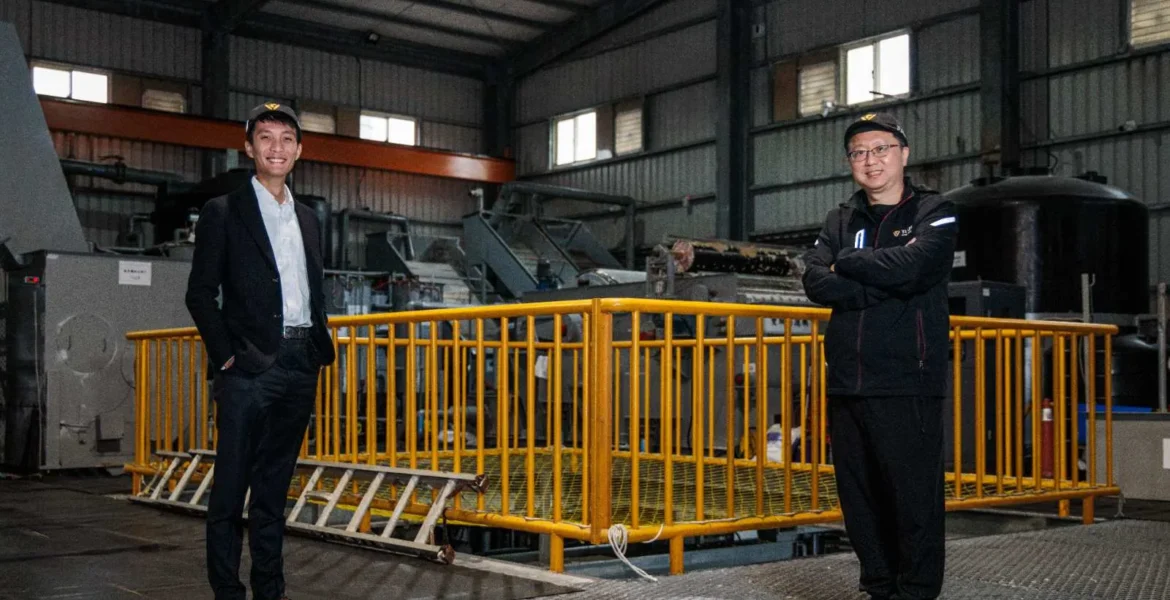
Diaper mountains pile up, incinerators refuse to burn them, and disposal fees skyrocket — how did they turn this into a recycling business opportunity?
Waste diapers account for 5% of Taiwan’s general waste, causing headaches for long-term care facilities and being unwelcome at incinerators. A PhD from National Tsing Hua University and a second-generation petrochemical entrepreneur saw the potential for a circular business. After 10 years of technology development and 7 years of efforts to obtain permits, Taiwan’s first diaper recycling plant is about to open—but what challenges remain?
At the end of 2015, Huang Shihan, then director of the Hsinchu County Environmental Protection Bureau, was overwhelmed by the diaper problem.
At that time, Taiwan faced a waste crisis. Aging incinerators were under collective maintenance, drastically reducing processing capacity. Counties and cities with incinerators prioritized their own waste, leaving places like Hsinchu and Nantou—without incinerators—facing mountains of garbage.
Huang promoted waste reduction and even sent staff to inspect garbage trucks, checking bags and returning those that didn’t meet regulations. Unexpectedly, …After reducing overall waste by 30%, they found that up to 10% of the remaining waste was diapers, which could only be sent to incinerators in other counties—becoming a major pain point.One sanitation supervisor, under immense pressure to reduce waste, even tried dehydrating the diapers to reduce their weight—but after a week, it still failed.
And that wasn’t all. The Environmental Protection Bureau’s sanitation teams prioritized household garbage, leaving businesses and institutions to arrange their own waste collection. Huang Shihan received complaints from long-term care facilities that they couldn’t properly dispose of their diapers.
It turned out that long-term care facilities handed their waste over to collection companies, and most of it was diapers. The diapers were too wet and could damage incinerators, causing many facilities to refuse burning them altogether.He originally planned to have the facilities arrange their own waste collection, but when he inspected the site, the scene shocked him. This semi-private long-term care facility specializes in caring for patients in vegetative states and with severe conditions. Operating was already difficult, and a recent typhoon had left the place in disarray. 'At the entrance, I saw a mountain of one to two tons of diapers,' he recalled. He quickly called in the military and volunteer groups to help, but he had no solution for the long term. At that time, Huang Sichun, a member of the Environmental Protection Bureau and a professor at Chung Hua University, learned of Huang Shihan’s predicament and introduced him to PhD student Wu Beiren. How could diaper recycling—something no one wanted to tackle—become a business opportunity? Wu Beiren, studying Biomedical Engineering and Environmental Science at National Tsing Hua University, specialized in decomposition. 'At first, the director wanted me to try breaking down the diapers to help the care facilities reduce waste, but the facility produced 30 tons of diapers per month, and the cost was staggering,' he said. Using his spare time, Wu built a demonstration plant for Huang Shihan and successfully decomposed the diapers into paper fibers, plastic, and SAP absorbent material. Unexpectedly, after this technology became known in the industry, many waste collection companies approached him—some even operating in legal gray areas, hoping to acquire Wu’s technology. Although no partnerships were made, Wu realized from this experience that...It turned out that diaper disposal was a major pain point for waste collection companies—and hidden within it was a huge business opportunity. In 2017, Mr. Pei-Jen Wu received an award from the Ministry of Environment. At the time, Lai Yingying, director of the Ministry’s Waste Management Division, decided to offer support. 'This technology can enable resource circulation and is cost-feasible, but an operational model is needed—for example, investors to build facilities and sufficient supply of materials,' Lai said. She helped introduce Wu to companies like Ruentex Group and Dahe Environmental, a leading incinerator operator. But at that time, Wu had no factory, permits, or clients. 'The meetings were over in five minutes—they thought I was wasting their time,' Wu recalled with a smile. It wasn’t until he met Qin Xijun, the second-generation heir of the Yizhou Group, that things began to turn around. Building Taiwan’s first dedicated facility, with permits taking 7 years The Yizhou Group was founded in 1975, primarily producing lubricants and transformer oils. Its founder, Qin Jiahong, also established nationwide gas stations and leased them to Formosa Plastics. In recent years, the veteran petrochemical group has actively diversified into biotechnology, real estate, and wind power. Qin Xijun, under 30, had several much older siblings already holding key positions in the company. After studying in the U.S. for one year, he decided to take a leave of absence and return to Taiwan. However, staying in the group meant he would only be seen as the 'little prince' or mascot. His father had even suggested he take back and operate the group’s leased gas stations himself—a relatively straightforward path.
But I wanted to do something more unique—a challenge that no one else dared to take on. Even a small success would be impressive," he said.Tasked with managing the group’s new investment ventures, Mr. Hsi-Chun Chin chose Mr. Pei-Jen Wu company. They focused on adult diapers from long-term care facilities, as these were easier to collect and recycle. In 2019, 'Yi Chun Green Technology' was established, investing NT$30 million to build a facility, and by 2024 it was listed on the Emerging Stock Board. The company’s primary revenue comes from charging waste collection companies for processing, with secondary income from selling the separated paper fibers and plastic pellets to companies that need recycled materials.
However, this is Taiwan’s first facility dedicated to diaper recycling, and even government agencies were unfamiliar with the process. Simply obtaining an operating permit took a full seven years.The Ministry of Environment supported diaper recycling, but long-term care facilities fall under the Ministry of Health and Welfare, making the approval process cautious and lengthy. Fortunately, the Ministry of Environment assisted in multiple communications, positioning Yi Chun Green Technology as a resource-reuse company rather than just a waste disposal business, which helped break the deadlock.Finally, in March, they obtained the nation’s first Ministry of Health and Welfare permit for the reuse of general medical waste. But a permit is just a ticket—would waste collection companies actually pay for it? Weicheng Environmental, the waste collector working with the most long-term care facilities in Taoyuan, faces the same challenges of limited incinerator capacity. Its manager, Fan Bowen, the second-generation successor, explained that during incinerator maintenance periods, incoming waste is strictly controlled, often through 'total volume restrictions.If on-site inspections find that the waste does not meet entry standards or is difficult to incinerate—for example, a truck full of soaking wet diapers—they may be required to return the load or reduce its volume. For him, having an additional outlet for waste disposal and reducing risk was a major incentive. 'When I first met Yi Chun, I didn’t quite believe it—how could diapers be reused? They showed me folders and business cards made from diaper paper fibers. I thought, this could ease our pressure on the incinerator, avoid being stuck, and stop us from constantly telling clients that this is not accepted or that is not accepted,' he said.
However, to cooperate with Yi Chun, Weicheng had to deploy an extra truck and hire an additional driver specifically to collect sorted diapers from long-term care facilities. For smaller waste collection companies, this isn’t cost-effective; Weicheng could only do it because they had a large enough base of long-term care clients. Fan Bowen frankly said that if it were his father’s generation, they might not have wanted the extra hassle. But he believes that although recycling diapers costs about the same as incineration, it is a more stable and sustainable disposal channel. The facilities that most urgently need a diaper solution are long-term care institutions. Reusing waste diapers prevents skyrocketing collection fees. Grace Nursing Home in Taoyuan participated in Yi Chun’s pilot operations. Its founder, Li Zhengxun, who once served as chairman of the Taoyuan Long-Term Care Association, said that diapers—soaked with water and surprisingly heavy—make up more than half of the facility’s monthly waste, and waste disposal costs alone can reach NT$80,000 per month. Even more worrisome for long-term care facilities is that these costs are dictated by the waste collection companies’ pricing.Because incinerators reject diapers, waste collection companies often raise their fees when disposal becomes difficult. What used to cost around NT$5,000–6,000 per month has now surged to over NT$60,000 monthly. Long-term care facilities have no choice but to absorb these increased costs themselves.Some facilities once tried to switch waste collection companies, only to face a joint refusal from other providers, leaving diapers piling up and rotting on-site. 'We have to bear the price fluctuations; small facilities can’t handle it and can only try to survive,' they said. Li Zhengxun and several other operators had nowhere to turn for help, and even whimsically considered pooling funds to buy land and build their own incinerator, or purchasing large-scale dehydration machines to reduce diaper weight. The emergence of Yi Chun provided a turning point. Previously, we had no say in negotiations with waste collection companies, but now Yi Chun can handle it for us, and the costs are stable,' they said. Currently, the fees Yi Chun charges the waste collectors are roughly the same as incineration costs. Through contracts, long-term care facilities no longer have to suffer from price fluctuations.Furthermore, with more processing channels at the backend, waste collectors have less reason to raise prices. However, training frontline caregivers to sort diapers accurately is a burden for long-term care facilities already stretched thin. Smaller facilities are often reluctant to switch waste collectors, fearing that trying a new cooperation model could backfire and lead to rejection by their previous provider. Yi Chun’s challenges don’t stop there. The 300-million-TWD factory in Taoyuan officially obtained its permit and started operations this year, but much equipment calibration is still needed. Revenue is projected at 10 million TWD for the year, far from profitable. 'We waited seven years for this license,' Qin Xijun said with a wry smile. The moment they received it, reality hit—'There’s no excuse for not generating revenue now, and we must focus on expanding the business.